Iris: The Geometry and Architecture of Iris

See my larger gallery of iris flowers.
Every time I see an iris, I think of my grandmother. She had a whole stretch of them along the side of her house, and in spring they’d all bloom at once. Purples, blues, yellows, whites—every color at the same time, like the garden couldn’t hold back anymore. And then, just as quickly, they’d be gone. That stuck with me.
I think that’s part of why I photograph them. They don’t slowly build up or last all season. They show up in full, like they’re not afraid to give everything, and then they fade. It feels important to hold onto that, even if only in a picture.
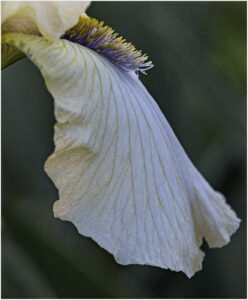
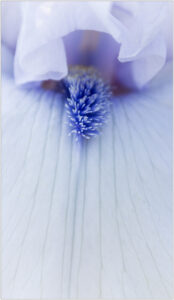
They’re different from most flowers. A tall bearded iris doesn’t make a simple circle of petals around a center. Its bloom is layered and complex. Three upright petals, called standards, arch together to form a dome, while three outer petals, called falls, bend outward and down in sweeping curves. Down the middle of each fall runs the beard, a fuzzy strip of hairs, often in a contrasting color that draws your eye straight into the center.
Inside that canopy, slender filaments and style arms stretch delicately across the falls. Up close, it feels almost like stepping under a vaulted ceiling, fine beams and threads spanning across the petals. And the whole arrangement repeats three times around the flower, so it’s never just one face you’re looking at. It’s three faces turning outward together, complete and balanced from every direction. The iris doesn’t hide a front or a back—it presents itself all at once.
What adds to their presence is their strength. For all their delicacy in detail, the flowers are anything but flimsy. Their thick stalks rise tall from the base, and the blooms hold their shape even in heavy rain, in sudden wind, in the blaze of summer sun. They don’t droop at the first challenge. They stand firm, holding their structure as if to remind you that beauty and resilience can exist in the same form.

Artists have seen them in different ways. Van Gogh painted them when he was in the middle of his own struggles, and they became symbols of hope and beauty for him. Georgia O’Keeffe leaned into their curves and saw something sensual there. For me, they feel carefully shaped, almost like small pieces of architecture rising out of the garden—balanced, deliberate, solid even in their short bloom. Even when the flowers are gone, the sharp leaves remain, steady and waiting for the next season.
For me, they’re not just flowers. They carry the memory of my grandmother’s garden, but also something larger—the quiet perfection of their form. Three arches rising, three curves falling, three faces turning outward. Balanced. Steady. Complete. That architecture stays in my mind long after the petals are gone, a reminder that even brief beauty can leave a lasting shape.