What These Essays Are For
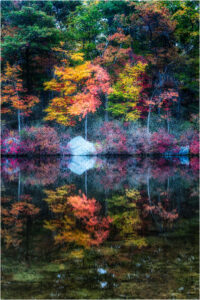 These started one day when I was out shooting. I was in Harriman Park, moving around a scene, and I changed lenses halfway through. I do that a lot. I’ll be standing somewhere and just feel that it would come together better through a different lens. Or that it might work in a different kind of light — evening, sunrise, maybe even infrared.
When that thought hits, I usually ask myself why. Why do I feel that? And when I do, it’s like opening a gate. All the small reasons, all the pieces of experience I’ve built up over time, rush in at once — the what, the where, the why of it all.
The first time I tried to write one of these essays, it was just to catch that moment. To hold onto what my mind was telling me before it faded. But the writing started doing something else. The more I tried to explain what I was seeing, the more it changed how I saw.
Writing about a lens or a kind of light takes something that used to live only in instinct and gives it a shape I can work with. It turns a feeling into something I can reach for later. The next time I’m in the field, that thought is still there — quiet, somewhere in the back — helping me see a little more deliberately.
The fisheye lens is a good example. It’s one thing to feel what it does — that strange pull toward the center, the way space seems to bend and lean. But it’s another thing to hold that in mind as you shoot.
I knew how a fisheye worked from experience. I knew that if I wanted something strong in the frame, I had to put it close to the lens. I knew that the fisheye shines when it has something to bring into prominence.
When I gave it a description — a sense of hierarchy based on importance instead of relation — I started to see what was really happening. The lens doesn’t just distort; it reorders the world. What’s closest becomes dominant, and everything else stretches away into the curve. Once I saw that clearly, I could work with it instead of just reacting to it.
Writing about it made that visible to me. It gave language to something I’d always felt but never named. And once it had words, it became something I could reach for on purpose — almost like a language of its own inside the photograph.
 That’s what these essays have become for me. They slow things down. They take what’s floating around — half-formed thoughts, quick flashes of understanding — and give them a place to land. Sometimes it’s just a sentence that stays with me. Other times it’s a whole idea that changes how I look the next time I’m out shooting.
When I write these, I’m not trying to teach or explain anything. I’m not trying to sound intellectual about it. These are written for me. I publish them here because I can — and maybe someone else will get something out of the way I explain things. But the purpose is for me to know my own style, my method, and my process better.
That’s what the writing gives back. It helps me understand what draws me to a photograph, or why I return to the same kind of light, or how certain patterns keep showing up. It makes me aware of what I might have missed, and that awareness changes everything.
The writing teaches the seeing, and the seeing gives the writing something to return to. They’ve become one practice now — a loop that keeps me curious, keeps me paying attention.
That’s what these essays are for. To catch what I almost miss. To name it just long enough to see it more clearly next time.