Vintage mill machinery
Composition Overview
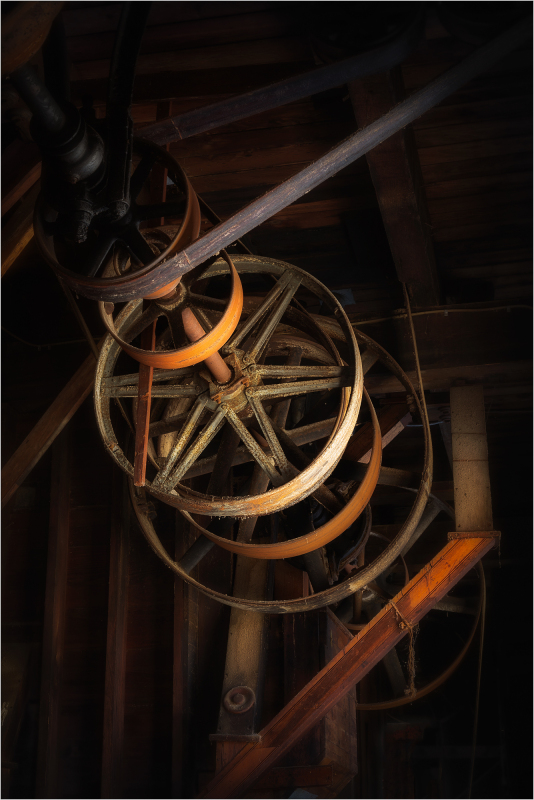
The image looks upward into the rafters of an old mill, isolating a cluster of wheels and belts suspended in shadow. A single light source rakes across the metal surfaces, revealing rust, dust, and age. The photograph is less about machinery in use and more about machinery as relic — a study of geometry, texture, and quiet history.
Subject Hierarchy
-
Primary subject: the large, central wheel angled diagonally, catching the most light.
-
Secondary subjects: surrounding wheels and belts, partially obscured but echoing the main form.
-
Supporting field: the wooden beams and structure that cradle the machinery, forming a dark backdrop.
Geometry & Structure
-
The main wheel is framed as a circle-within-circles, reinforced by belts looping around.
-
Strong diagonals (wooden beams, shafts) cut through the composition, crossing behind the wheels.
-
The entire arrangement reads as an interlocked web — circles layered against angled lines.
Lines & Movement
-
The belts act as curving vectors, guiding the eye around the loops.
-
Diagonal wooden beams direct the gaze upward and back into depth, pulling vision through the frame.
-
The spokes of the wheel radiate outward, creating centrifugal rhythm that suggests motion even though the machinery is still.
Balance & Tension
-
Off-center placement of the main wheel creates dynamic balance.
-
Dark negative space at the edges contrasts with the illuminated metal, producing tension between presence and absence.
-
Repetition of circular forms stabilizes the asymmetry.
Depth & Scale
-
Overlapping belts and wheels create layering, giving three-dimensionality.
-
Recurring diagonals recede into the upper darkness, extending depth beyond what is visible.
-
Scale is suggested not by full context but by the weight and rust of the metal, which imply human-sized machinery.
Tone & Texture
-
Light skims across rusted metal and frayed belts, emphasizing age and tactile detail.
-
The wooden beams absorb more shadow, giving a softer texture that contrasts with the hard-edged metal.
-
Tonal range moves from near-black shadows into muted highlights, keeping atmosphere moody and quiet.
Negative Space
-
The surrounding darkness isolates the machinery, stripping away distractions and turning the gears into sculptural objects.
-
Empty patches above and around the pulleys allow the eye to rest before re-entering the intricate core.
Perceptual Inflections
-
At the central wheel: from object to symbol, the gear shifts from being just machinery to embodying the passage of time.
-
Along the belts: from line to loop, the straps are both connectors and compositional guides.
-
In the darkness: from obscurity to imagination, the unseen becomes part of the experience, suggesting the mill’s larger hidden system.