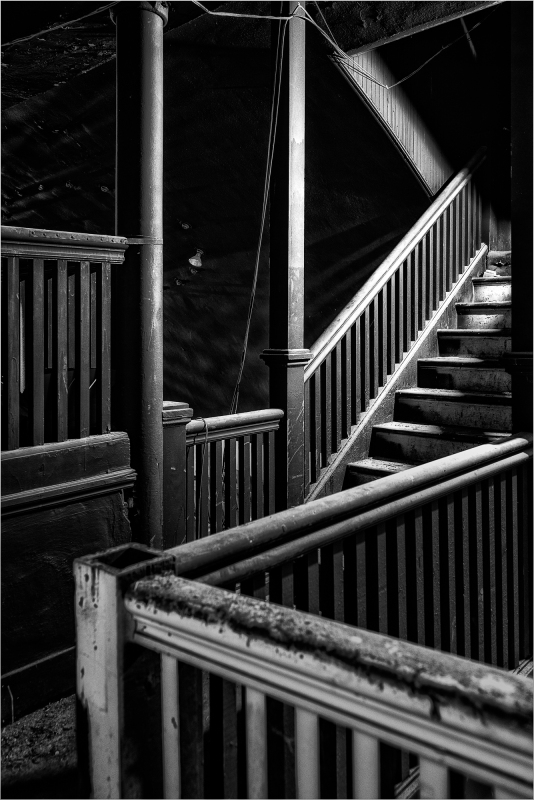
Weathered wooden staircase
Composition Overview
The photograph captures a worn staircase in stark black and white, lit from above so the rails and steps glow against deep shadows. It is a study in geometry and light: lines converge and overlap, creating a layered structure that feels both architectural and psychological. The scene is empty of people but charged with their traces — peeling paint, worn banisters, cables hanging loose.
Subject Hierarchy
-
Primary subject: the staircase rising diagonally, illuminated in strong contrast.
-
Secondary subjects: vertical posts and railings forming a lattice around the stairs.
-
Supporting field: shadowed walls and dark voids, holding the geometry in tension.
Geometry & Structure
-
The staircase forms the dominant diagonal, cutting through the frame with clarity.
-
Repetition of vertical balusters sets up a rhythmic pattern across multiple planes.
-
Horizontal railings and landings divide the frame into stacked compartments, like boxes of light and shadow.
Lines & Movement
-
The eye follows the diagonal of the stairs upward into brightness, then retraces down along the vertical posts.
-
Crossbars and railings interrupt the climb, forcing pauses and redirections.
-
Hanging wires provide irregular, organic counter-lines to the rigid architecture.
Balance & Tension
-
Strong contrast between illuminated banisters and dark walls builds tension between presence and absence.
-
Balanced asymmetry: the staircase leans right, but central posts and rails stabilize the composition.
-
Repetition of parallel lines is unsettled by decay and irregular textures, keeping the image alive.
Depth & Scale
-
Multiple layers of railing create a foreground–midground–background progression.
-
Light and shadow deepen the space, making the staircase feel like it recedes into mystery.
-
Human scale is implied through the railing height and stair size, even without figures present.
Tone & Texture
-
High-contrast black and white emphasizes structure and grit.
-
Painted surfaces show wear and peeling, adding a tactile sense of history.
-
Light grazes across the stair edges, highlighting dust and erosion.
Negative Space
-
Deep black voids surround the stairs, amplifying their brightness.
-
Shadowed planes on the walls create abstract fields that frame the geometry.
-
Empty space beneath the staircase keeps the composition from becoming too dense.
Perceptual Inflections
-
At the first step: from grounded to rising — the image asks the eye to ascend.
-
Along the railing: from order to decay — rhythm of the balusters shifts into irregularities of wear.
-
In the shadows: from clarity to mystery — what’s hidden becomes as important as what’s seen.