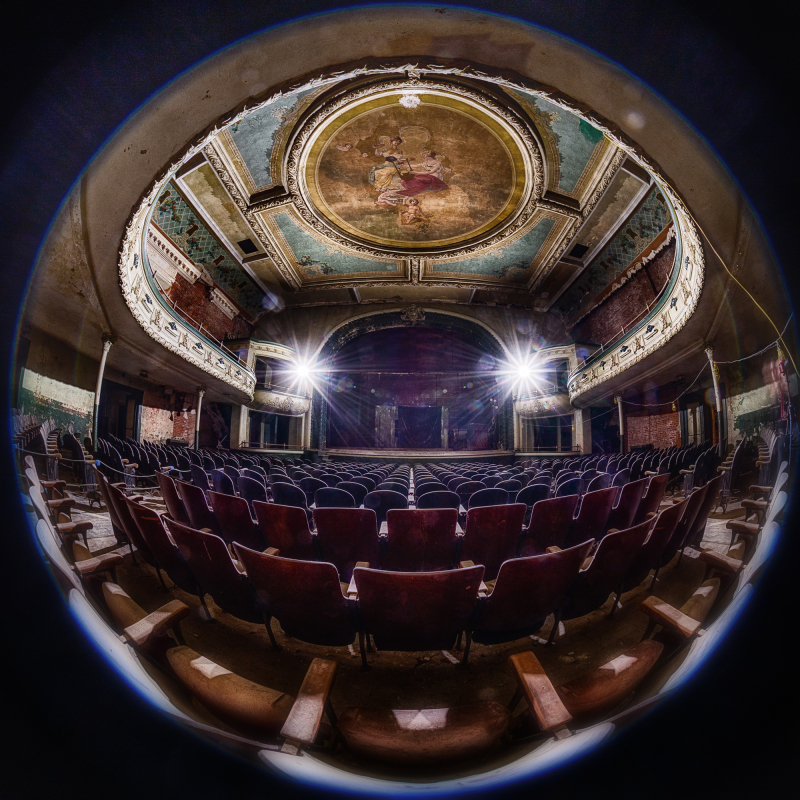
Interior of the Orpheum Theater, showcasing ornate ceiling and empty red seats.
This photograph took me forever to get right. I had a vision in my mind of what I wanted, but it took almost an hour of tiny adjustments to get everything lined up — and even then it still isn’t perfect.
I was using a fisheye lens, which twists everything toward its own reality. It curves the world in on itself. In this space, that meant several elements could be drawn together: the circular medallion in the ceiling, the horseshoe mezzanine, the arch of the stage, and the rows of seats.
With the fisheye, the straight rows of seats bend upward, forming repeating curves that lead from the bottom of the frame toward the stage. That rhythm pulls your eye upward. At the same time, the medallion in the ceiling becomes the central subject — the thing I most wanted you to look at.
What makes the composition work is the repetition of curves. The circular medallion is echoed in the oval of the mezzanine. The arch of the stage adds another curve in the same rhythm. One after another, these shapes repeat and build on each other throughout the frame.
The hardest part was alignment. I wanted the camera perfectly centered on the stage, pointed directly toward the back wall. At the same time, I needed to angle it upward so the medallion and the surrounding shapes would all line up. I deliberately didn’t center the medallion, because the whole image depends on the supporting shapes working together — the seats, the mezzanine, the arch — all repeating and pointing you upward.
The result is a composition that draws you in from the bottom, step by step, until you reach the medallion. The curved lines of the seats, the symmetry of the mezzanine, the arch of the stage — all of them circling and guiding your eye. The medallion is what you notice last, but only because everything else is working to take you there.