Stairwell casting shadows
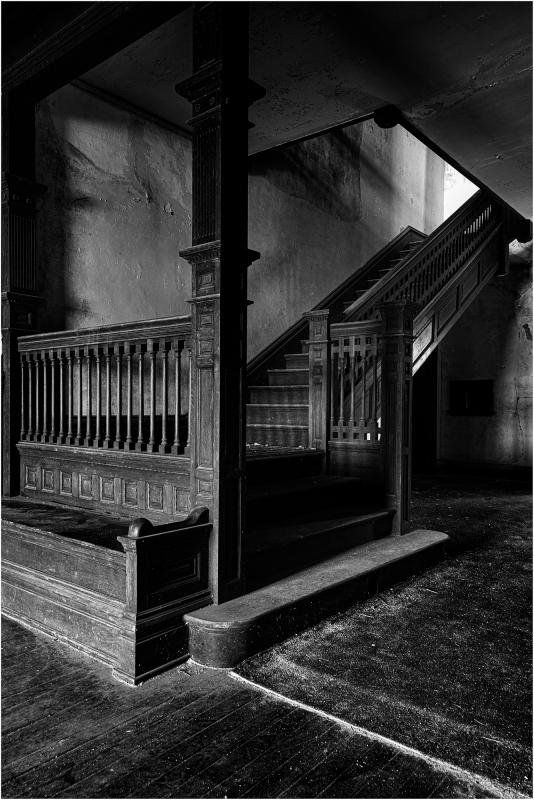
I spent a while moving around this staircase before it came together. The composition depended on getting just the right angle — one that let the lines meet cleanly without distorting too much. I was shooting with a 24mm lens, wide enough to take in the whole space but close enough to still feel part of it. Even a few inches of height made a difference. I lowered the tripod until the tilt of the stairs and railings felt balanced, so the scene opened naturally instead of leaning or collapsing.
I wanted that center column to be the anchor. It’s the closest thing to you, the point where the whole structure seems to pivot. Almost every line in the room feels like it generates from it — the stairs rising diagonally, the railing lines repeating behind, the ceiling beams carrying the same rhythm. When the camera found that position, everything built off the post as if it had been designed that way.
The light came in from the left, hit the railing, and climbed the stairs. That slow upward movement of light guided the eye through the frame, ending at the bright landing at the top — a soft focal point that held the image together. The deep tone of the wood carried the weight. It gave the structure its gravity against the lighter walls and ceiling.
The shadows were dark enough to hold the mood but not so deep that they lost detail. You can still see the grain of the wood, the cracked plaster, the years in the surface. I liked how the repeated verticals of the railings echoed each other — front, middle, and back — keeping the rhythm steady across planes.
I paid attention to the small alignments. The edge of the carpet needed to pull into the scene without cutting it. I shifted until that line flowed naturally from the bottom of the frame toward the stairs. The bottom steps had to stay visible, but I wanted them to overlap the column slightly — just enough for the depth to register. That tiny visual touch between post and step gave the whole image its sense of spatial relationship.
When I finally stepped back and looked through the viewfinder, everything felt right. The angles balanced, the light walked upward, the structure held. It was quiet, stable, and alive at the same time. It felt like the picture had been waiting for me to find that exact spot — to notice how all those lines wanted to meet.